
It is still early days to fully size the impact of the current pandemic on the global economy, not to mention IoT. Nonetheless, what is important to note for both the enterprise and consumer is that IoT is not just about connecting devices, it is about using and analyzing the data these devices collect to achieve an outcome.
By no means do we think we have all the answers; the degree of uncertainty is still high– from the overall economic impact, to changes in consumer spend, and how enterprises in different verticals respond to the ‘new normal’. Rather, our analysis is a reflection on how the market has responded to Covid-19 so far and how we see (at this time) the future, recognizing that, for both the enterprise and consumer, IoT is not just about connecting devices but about using and analyzing the data these devices collect to achieve an outcome. And, of course, we will continue to monitor market developments, plough through quarterly reports, talk with the ecosystem players to try to gauge where the market is moving.
With that in mind, our views and analysis are guided by some top-level assumptions that underpin our latest forecast thinking.
Recession looms
Based on IMF data, global GDP will contract by 3 per cent this year and grow by
5.8 per cent in 2021. Whether or not these predictions still hold true is up
for debate. Regardless, recent news suggests that the current crisis is far
worse than the 2007-2008 financial crisis, pointing towards a U-shaped recovery
in economic output, rather than the hoped for V-shaped fast recovery. As such,
we look at any IoT market impact from a short-term and long-term perspective.
The ‘new normal’
On the demand side, the picture isn’t rosy. The Manufacturing PMI (Purchasing
Manager Index), measuring the health of the economy, has nose-dived. This
reflects low business confidence. Consumer confidence indexes have plummeted
too, due to growth in unemployment and limited spending power. Almost overnight
a large proportion of employees moved to a remote working environment, which
increased enterprises’ urge to support their workers via cloud based software
applications. On the supply side, production has been impacted as manufacturers
had to deal with supply chain disruptions, often looking to find alternative
providers. China’s rapid re-opening has helped remedy some of these issues.
But, in the longer-term, enterprises will look to build yet more resilience
into their supply chains to be able to ‘track and trace’ and have visibility of
their asset. Potentially, they will be also looking for a greater geographic
spread of suppliers, and even at the potential for re-shoring – building
greenfield operations to support in-country production.
The impact on IoT
Government measures put in place, related to social distancing, impacted travel
and site visit restrictions, holding back services and project installations
across all sectors. They have also underlined the importance of ‘out-of-the-box’
services that just work and can be easily deployed without specialists present.
We’ve observed this trend on the consumer side, especially with regards to home
security – self installed security cameras are on the rise. Granted, when it
comes to enterprises, customized solutions are the preferred option as our
survey shows, but this crisis might shift the status quo. In the short term,
companies have been using software tools to ensure business continuity.


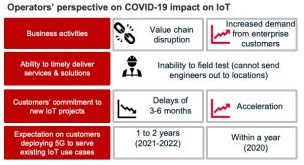
But what is the market actually saying? On the back of the launch of the 5G IoT for Manufacturing Forum a short survey to measure companies’ sentiment toward the impact of Covid-19 on their operations and ability to conduct BAU/provide services is being run.
Below are some of the key findings:
- Increase in automation, use of advanced analytics and increase in agility as a result of COVID-19
- Expectation that COVID-19 will increase customer demand for 5G while potentially shifting timelines
- Manufacturers see impact due to government measures – social distancing but overall, they see a rebound in the long term
The major downsides
We expect connected vehicles to be the most impacted sector across consumer
IoT. Even before Covid-19 stopped cars rolling off the production line, new car
sales had been slowing. This, combined with weak consumer demand, results in
our expectations that connected vehicle growth will be less than 2 per cent in
2020 – compared to previous double-digit growth. The retail sector, for its
part, will be forever changed, as the move to online channels accelerates. It’s
important to recognize that a large proportion of retail stores are SMEs, many
of which will struggle to survive the current crisis. Those that do, will most
likely have to embrace digitalization. Smart city projects are also currently
put on hold with cities having to reprioritize their budgets to focus on
citizen safety. Interestingly, the crisis has highlighted the role drones and
thermal cameras can play to monitor citizens or robots to sanitize the streets.
The hopeful upside
The current crisis has proven that companies that have already embarked on the
digital transformation journey are faring much better. According to our 2019
IoT Enterprise Survey, 65 per cent of companies deployed IoT as part of their
digital transformation agenda. Some of the planned deployments, especially for
SMEs, will either never happen or be put on hold. But this isn’t true across
the board. Smart health, including prescribed and non-prescribed medical
devices, will grow even faster than we would have expected just six months ago.
The current crisis has highlighted that globally, public health systems are
struggling to cope; when the dust settles, and perhaps even ahead of a vaccine,
post-mortems of where failings were made will focus on where technology can
help, even if that does mean relaxing regulations. Telemedicine and remote
patient monitoring are two areas that will be prioritized in developed nations.
Similarly, smart buildings as a sector will change. Working from home practices
are here to stay and this will have an impact on office space requirements, but
at the same time health and safety measures will have to be put in place to
ensure those who return to the workplace are not placed at risk.
What does it mean?
When all is said and done, after analysis of market trends at a global level,
our forecast is seemingly unchanged: 24 billion IoT connections in 2025 vs 24.6
billion that we forecast at the end of 2019. As surprising as it might seem, we
foresee that the immediate downturn will result in longer-term IoT adoption as
enterprises will look to achieve business benefits (cost reduction, increase in
revenue etc).
As history has shown, every crisis leaves a long-lasting legacy in terms of faster innovation and a ‘new normal’. Covid-19 will accelerate the move to digital and companies adopting IoT, AI/ML and 5G amongst other technologies to drive digital transformation.
source : https://www.mobileworldlive.com/blog/intelligence-brief-covid-19-and-what-it-means-for-iot/
Leave a Reply