Technology

Categories, unlike tags, can have a hierarchy.

Will Autonomous Vehicles (AV) in the Future be Electric?

Will Autonomous Vehicles (AV) in the Future be Electric? 150 150 Aditya Kristanto

Image result for autonomous vehicles

A recent study by researchers at BU’s Institute for Sustainable Energy estimates that by 2050 the likely net increase in electricity demand from converting the light duty vehicle fleet to 85% electric and autonomous vehicles (AVs) will be between 13% to 26% of today’s total electricity demand. With an increasingly green electricity mix, this could be great news for those concerned about the climate impacts of cars in general and autonomy and ride-hailing in particular.  Nevertheless, this outcome hinges on one major underlying assumption: that all AVs will also be electric vehicles (EVs).

There are many compelling reasons to assume autonomous vehicles will eventually adopt electric powertrains, and some indications point to a rosy outlook. GM’s Mary Barra proclaimed her allegiance to a future with “zero crashes, zero emissions, and zero congestion.” In March, Waymo announced a partnership with Jaguar’s I-PACE that should bring up to 20,000 EAVs to the road in the coming years.

Yet there are also more concerning signposts. This past fall, Uber—reigning king of ride hailing companies—signed a major deal with Volvo to develop their automation software using 24,000 gasoline-powered autonomous Volvo SUVs. Ford also recently declared that their AVs would not be electric. If these trends continue, the much-needed transition away from carbon-intensive vehicle fuels could be even further delayed—a disastrous result for climate change.

Five reasons to expect (and push for) electric autonomy

The benefits of electric over gasoline powertrains are amplified when placed in an AV—so much so that it seems only logical that all AVs will be electric. Here’s why.

Reason 1: Electrification means far less down time for maintenance. Vehicle owners usually prefer vehicles with lower maintenance needs, and this preference will only get stronger with automation. Today, most vehicles are parked 95% of the time, and even at these extremely low usage rates, regular maintenance is required to avoid breakdowns. With human drivers eliminated, AVs can operate for longer periods of time and over longer distances, leading to increased wear and tear. Simple maintenance like an oil change every 5,000 miles may suddenly become a monthly (and expensive) frustration. Especially for fleet operators (e.g., AV taxis), vehicle downtime will become an increasingly important concern. With far fewer moving parts and simpler powertrains, EVs have substantially less maintenance requirements compared to gasoline-powered vehicles, which translates into more hours on the road than in the shop.

Reason 2: Electrification is cheaper. EVs are cheaper to fuel and maintain. Over the lifetime of a vehicle, today’s EVs are already on par or cheaper than their combustion-engine counterparts, and per-mile costs will only further decline as battery costs continue to drop. Even at today’s relatively low vehicle usage rates, annual maintenance costs for EVs are estimated to cost between 9% and 18% less than gasoline-powered vehicles according to a new study. These savings will be magnified as vehicle usage increases through automation, giving EVs a clear competitive advantage on price in the market.

Reason 3: It’s a winning proposition for utilities. As grid loads decline due to increases in efficiency and increases in off-grid renewable energy supplies, utilities will look to EVs as a way to smooth (and increase) load. As AVs become a larger segment of the light-duty vehicle fleet, utilities can take advantage of the massive distributed battery bank in electric AVs to increase demand, balance loads, and support a more resilient electricity grid.

Reason 4: Electric charging is easier to manage without a human operator. One of the few drawbacks of EVs is that they take a long time to charge. Even using fast-charging technology, an EV can take as long as half an hour to charge to 80% of its full driving range. However, when EVs drive themselves, they can search for charging stations on their own, reducing the burden of wait time. Furthermore, the advent of wireless charging through inductive charging stations or inductive EV highways could make charging safer and more easily automated and integrated than refueling autonomous gasoline vehicles.

Reason 5: The Climate (of course). Since 2016, transportation has remained the single largest contributing sector of CO2 emissions in the U.S. As the electricity grid continues to decarbonize, that proportion will only grow higher. Vehicle automation could create a magnifying effect in either direction through increased vehicle usage: electric AVs could facilitate the decarbonization of the transportation sector, whereas gasoline-powered AVs could exacerbate transportation-related carbon emissions.

Three reasons gasoline-powered AVs may arrive first (and stay around)

Despite the obvious benefits of electric AVs, achieving that reality may be more complicated than what you would like you to believe.

Reason 1: Computational Intensity. Fully autonomous vehicles are estimated to require the power of 50 to 100 laptops—about 1/10th of the size of a current Nissan Leaf battery. Range anxiety and high prices are already serious concerns for today’s EVs, and adding the energy draw for AV computing power may only amplify those concerns by either reducing range or increasing costs due to larger batteries. On the other hand, AV computational efficiency is consistently improving, and with their simpler powertrains EVs may be less computationally intensive to automate than gasoline-powered vehicles.

Reason 2: Infrastructure Costs. A recent NREL study concluded that electrifying 15 million EVs by 2030 (a mere 5% of the U.S. private vehicle fleet) would require close to 5,000 fast charging station and nearly 500,000 slow charging stations. Meanwhile, nearly 300 million gasoline-powered vehicles are fueled by just 168,000 gasoline stations with an established set of behaviors and expectations (e.g., refueling in under 5 minutes). The readily-available network of refueling stations significantly lowers the barriers to the adoption of gasoline-powered over electric AVs.

Reason 3: Path Dependency. Personal vehicles are part of a complex and interconnected mobility system that involves automakers, oil companies, fueling stations, political lobbyists, and customers, among other stakeholders. With over a century of market dominance, the personal vehicle mobility system is completely centered around the internal combustion engine and the oil that fuels it. Since the upfront costs of gasoline-powered vehicles are cheaper than EVs (at least for the time being), they will likely be (and in many cases already are) the test platform of choice for developing new AV technologies. As AV technologies develop, it may be difficult to convert the systems developed for gasoline vehicles to EVs. For example, many new AV control systems are being developed using “machine learning” algorithms which require thousands (if not millions) of hours of driving time to calibrate. The lack of hours spent training in EVs (which have very different performance characteristics) may render them infeasible compared to gasoline-powered AVs. The risk of path-dependent technological development may leave electric AVs “behind the curve” against gasoline-powered AVs.

How much does Electrification Matter?

Autonomous vehicle technology can increase the overall energy consumption from vehicles through a variety of interconnected ways. For example, increased access to currently non-driving populations (such as children and the elderly) can lead to increased demand and increased congestion, reducing the overall efficiency for every vehicle on the road in terms of energy use per mile. Electrification may be one of the best ways to avoid these increases. At the ISE, we are currently examining the details of these substitutions to understand the climate change implications of further vehicle automation.

Act now, not later.

Autonomous vehicles are moving from science fiction to a very near-term reality. As of late December 2017, futurists were certain that AVs were still years away, but recent high-profile accidents offer sharp reminders that AVs are already in our midst. The time to consider the potential climate impacts of autonomous vehicles is now, and current trends indicate that a future of electric AVs is not a certainty.

One way to shape this future is to demand electric AVs be part of testing fleets. AV companies are in an all-out race to establish partnerships with cities all over the world to test their innovations and establish market dominance. In response, cities should demand that multiple different powertrains be included in AV testing to avoid path-dependent technology lock-in. By shaping the testing grounds, cities around the world can work with AV firms to steer the development path towards a more sustainable future.

source : https://www.bu.edu/ise/2018/08/27/will-autonomous-vehicles-be-electric/

Covid-19 and what it means for IoT

Covid-19 and what it means for IoT 150 150 Aditya Kristanto

It is still early days to fully size the impact of the current pandemic on the global economy, not to mention IoT. Nonetheless, what is important to note for both the enterprise and consumer is that IoT is not just about connecting devices, it is about using and analyzing the data these devices collect to achieve an outcome.

By no means do we think we have all the answers; the degree of uncertainty is still high– from the overall economic impact, to changes in consumer spend, and how enterprises in different verticals respond to the ‘new normal’. Rather, our analysis is a reflection on how the market has responded to Covid-19 so far and how we see (at this time) the future, recognizing that, for both the enterprise and consumer, IoT is not just about connecting devices but about using and analyzing the data these devices collect to achieve an outcome. And, of course, we will continue to monitor market developments, plough through quarterly reports, talk with the ecosystem players to try to gauge where the market is moving.

With that in mind, our views and analysis are guided by some top-level assumptions that underpin our latest forecast thinking.

Recession looms
Based on IMF data, global GDP will contract by 3 per cent this year and grow by 5.8 per cent in 2021. Whether or not these predictions still hold true is up for debate. Regardless, recent news suggests that the current crisis is far worse than the 2007-2008 financial crisis, pointing towards a U-shaped recovery in economic output, rather than the hoped for V-shaped fast recovery. As such, we look at any IoT market impact from a short-term and long-term perspective.

The ‘new normal’
On the demand side, the picture isn’t rosy. The Manufacturing PMI (Purchasing Manager Index), measuring the health of the economy, has nose-dived. This reflects low business confidence. Consumer confidence indexes have plummeted too, due to growth in unemployment and limited spending power. Almost overnight a large proportion of employees moved to a remote working environment, which increased enterprises’ urge to support their workers via cloud based software applications.  On the supply side, production has been impacted as manufacturers had to deal with supply chain disruptions, often looking to find alternative providers. China’s rapid re-opening has helped remedy some of these issues. But, in the longer-term, enterprises will look to build yet more resilience into their supply chains to be able to ‘track and trace’ and have visibility of their asset. Potentially, they will be also looking for a greater geographic spread of suppliers, and even at the potential for re-shoring – building greenfield operations to support in-country production.

The impact on IoT
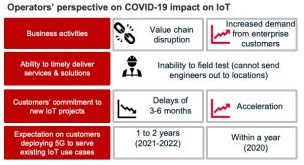
Government measures put in place, related to social distancing, impacted travel and site visit restrictions, holding back services and project installations across all sectors. They have also underlined the importance of ‘out-of-the-box’ services that just work and can be easily deployed without specialists present. We’ve observed this trend on the consumer side, especially with regards to home security – self installed security cameras are on the rise. Granted, when it comes to enterprises, customized solutions are the preferred option as our survey shows, but this crisis might shift the status quo. In the short term, companies have been using software tools to ensure business continuity.

https://www.mobileworldlive.com/wp-content/uploads/2020/05/GSMAi2-1-300x161.jpg

But what is the market actually saying? On the back of the launch of the 5G IoT for Manufacturing Forum a short survey to measure companies’ sentiment toward the impact of Covid-19 on their operations and ability to conduct BAU/provide services is being run.

Below are some of the key findings:

  • Increase in automation, use of advanced analytics and increase in agility as a result of COVID-19
  • Expectation that COVID-19 will increase customer demand for 5G while potentially shifting timelines
  • Manufacturers see impact due to government measures – social distancing but overall, they see a rebound in the long term

The major downsides
We expect connected vehicles to be the most impacted sector across consumer IoT. Even before Covid-19 stopped cars rolling off the production line, new car sales had been slowing. This, combined with weak consumer demand, results in our expectations that connected vehicle growth will be less than 2 per cent in 2020 – compared to previous double-digit growth. The retail sector, for its part, will be forever changed, as the move to online channels accelerates. It’s important to recognize that a large proportion of retail stores are SMEs, many of which will struggle to survive the current crisis. Those that do, will most likely have to embrace digitalization. Smart city projects are also currently put on hold with cities having to reprioritize their budgets to focus on citizen safety. Interestingly, the crisis has highlighted the role drones and thermal cameras can play to monitor citizens or robots to sanitize the streets.

The hopeful upside
The current crisis has proven that companies that have already embarked on the digital transformation journey are faring much better. According to our 2019 IoT Enterprise Survey, 65 per cent of companies deployed IoT as part of their digital transformation agenda. Some of the planned deployments, especially for SMEs, will either never happen or be put on hold. But this isn’t true across the board. Smart health, including prescribed and non-prescribed medical devices, will grow even faster than we would have expected just six months ago. The current crisis has highlighted that globally, public health systems are struggling to cope; when the dust settles, and perhaps even ahead of a vaccine, post-mortems of where failings were made will focus on where technology can help, even if that does mean relaxing regulations. Telemedicine and remote patient monitoring are two areas that will be prioritized in developed nations. Similarly, smart buildings as a sector will change. Working from home practices are here to stay and this will have an impact on office space requirements, but at the same time health and safety measures will have to be put in place to ensure those who return to the workplace are not placed at risk.

What does it mean?
When all is said and done, after analysis of market trends at a global level, our forecast is seemingly unchanged: 24 billion IoT connections in 2025 vs 24.6 billion that we forecast at the end of 2019. As surprising as it might seem, we foresee that the immediate downturn will result in longer-term IoT adoption as enterprises will look to achieve business benefits (cost reduction, increase in revenue etc).

As history has shown, every crisis leaves a long-lasting legacy in terms of faster innovation and a ‘new normal’. Covid-19 will accelerate the move to digital and companies adopting IoT, AI/ML and 5G amongst other technologies to drive digital transformation.

source : https://www.mobileworldlive.com/blog/intelligence-brief-covid-19-and-what-it-means-for-iot/

If robots could recycle: How technology innovation can help solve plastic pollution

If robots could recycle: How technology innovation can help solve plastic pollution 1540 800 Aditya Kristanto

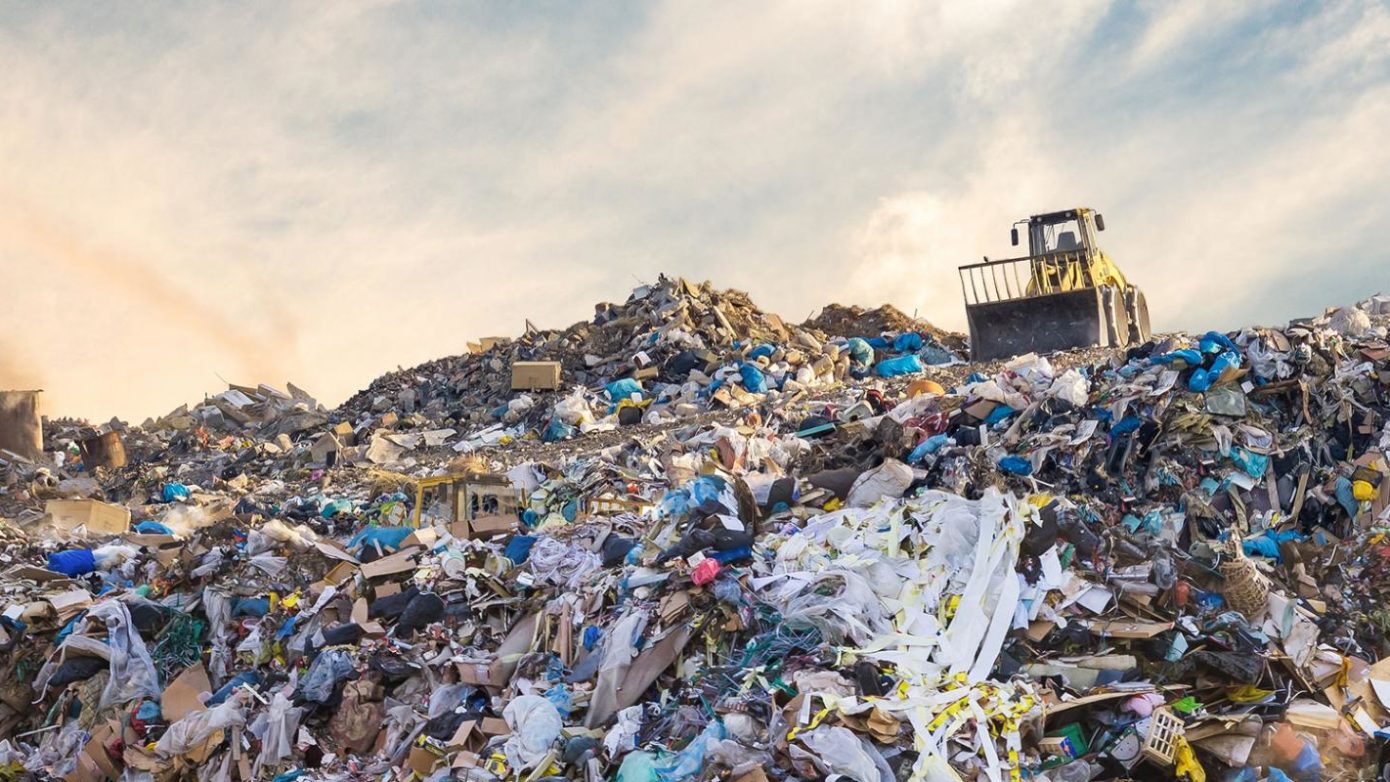
Global plastics production increased from 225 million metric tons in 2014 to 335 metric tons in 2016, of which only 16% is recycled. The other 84% is either dumped into landfill or makes its way into the ecosystem, causing a tremendous amount of pollution. The Ellen MacArthur Foundation estimates that, by 2050, there will be more plastic in the ocean than fish (by weight). The Great Pacific Garbage patch, 99.9% of which is plastic, covers an area three times the size of Spain.

Images of turtles with straws in their noses and dead whales with almost 90 lbs of plastic in their stomach have drawn attention to several problems: how to prevent plastic from entering the ocean and how we can recover and recycle the plastics we have. National Geographic keeps a running list of actions around the world to stop plastics from getting into the ocean. As for recycling what we have, the good news is investments in recycling and waste technologies reached a five-year record high in 2018, and there many opportunities for corporations to collaborate with innovative solutions.

New recycling processes

Plastic is a valuable material. US$80-US$120 billion is lost annually from discarding plastic packaging after first use. One study estimates that new and profitable plastics-recycling businesses could represent a global profit pool of US$55 billion by 2030. In addition, the PET and polyester industry represents another US$130 billion addressable market for recycled plastics. Producing recycled plastic reduces energy consumption by 87% compared to making new plastics.

Outdated and unsustainable recycling and reuse methods have not been working. Recycling innovation is occurring in several key areas: automation and robotics in mechanical processes and new chemical recycling processes.

Mechanical recycling

Mechanical recycling involves physically processing plastic down to resin pellets, leaving the polymer chain intact. This process involves grinding, washing, separation, drying, regranulating, and compounding the plastic. Some of the challenges with mechanical recycling are maintaining the integrity of the plastic, limited solutions for contaminated waste streams (curbside and post-consumer waste), a limited range of plastic types that can be recycled, and a lack of solutions for additives and dyes.

Opportunity – scaling through automation

Traditionally, plastics sorting has been done manually; the next generation is artificial intelligence-powered robotic automation. This technology can identify types of polymers with accuracy close to that of a human at lower costs and greater speeds, which produces high purity output at lower costs. In addition, mechanical recycling is a dirty and dangerous industry, making it a prime target for robotic automation.

AMP Robotics, ZenRobotics and Waste Robotics are developing AI-powered robots to sort through waste streams more efficiently and at a lower cost than humans. AMP Robotics’ sorting and picking system can complete 80 picks per minute and the equivalent of three human shifts a day. The company recently partnered with Ryohshin to develop industrial automation for construction and demolition recycling. Waste Robotics promises a 300% productivity increase and recently received funding from the Canadian government to commercialize the technology. ZenRobotics announced partnerships with Skrotfrag, Spross, Ferrovial, Lundstams, Sogetri and Zanker Recycling in 2018-2019 to deploy ZenRobotics’ recycling technology. These emerging technologies seek to produce a higher volume of quality recycled plastics that would be competitive with conventional plastics.

Chemical recycling

Chemical recycling, or monomer recycling, involves chemical processes that break polymers down to monomers by breaking down the polymer chains to hydrocarbon fractions using either catalytic or thermal processing. The end product is then sold into virgin plastic production markets. This method has some advantages over mechanical recycling, as it can better deal with contaminated waste streams, additives and dyes and produces the chemical building blocks of polymers, which can be used and recycled an infinite number of times without downgrading the recycled product.

Opportunity – reducing costs and increasing efficiency through innovative processes.

The primary new chemical recycling process under development is thermal pyrolysis, which is the decomposition of materials using high temperatures. Although thermal pyrolysis can effectively deal with contaminated, mixed-waste streams, it requires a significant energy input to reach the required temperatures, resulting in process inefficiencies. An alternative to thermal pyrolysis is catalytic pyrolysis, which uses a catalyst, rather than heat, to break down polymers. Although this technique produces a higher-quality liquid output than thermal pyrolysis, it is still costly and requires a high energy demand.

Loop Industries has developed a chemical recycling process that can produce high-purity, food-grade PET plastic from a wide range of waste plastic, including mixed and contaminated post-consumer streams. The depolymerization technology uses zero energy inputs, making it much more efficient than typical pyrolysis or catalyst technologies. Loop’s technology produces PET monomers (Dimethyl Terepthalate and Mono Ethylene Glycol) for use as virgin feed-stock at costs competitive with fossil-derived feed-stock. The technology’s advantages over pyrolysis and economic attractiveness have allowed Loop to develop partnerships with global corporations such as PepsiCo, Danone/Evian, L’Oreal, Nestlé, Gatorade, Indorama, Thysenkrupp, and Coca Cola, all which have occurred in the past two years.

Agilyx has developed a chemical recycling process to transform hard-to-recycle and low-quality plastics waste – which represent 75% of waste plastic – into a refinery-grade crude oil feed-stock for new products and a first-of-its-kind technology to break down polystyrene, which is used in Styrofoam, into styrene monomer. Since 2012, Agilyx has partnered with Therma-Flite, INEOS Styrolution, Americas Styrenics (AmSty) and Monroe Energy to deploy its technology. In addition, Agilyx’s technology is beginning to reach commercial scale with last year’s opening of the world’s first commercial waste Polystyrene-to-Styrene Oil chemical recycling plant.

Where is the industry heading next?

Although these technologies and partnerships are promising, recycling innovation is still in its infancy and will require stakeholder participation along the entire value chain, from consumers to collectors to end-users of recycled plastics. As recycling technology develops and is better able to handle a large variety and volume of plastics waste, more innovation will be necessary in collection and sorting to ensure that all discarded plastics make their way into the recycling process. In addition, new alternative plastics materials will help ensure that the materials inevitably leaking from the system will quickly biodegrade, rather than wreaking environmental havoc for centuries.

source : https://plasticfree-world.com/